Train Brand-Specific LLMs: High-Converting Social Copy with 94% Voice Accuracy
Advertisements
Brand-specific LLMs for social media copy can help marketing teams produce consistent messages through structured brand guidelines, curated examples, prompt optimization, and systematic evaluations. Learn how to measure brand voice accuracy, improve conversion performance, and deploy AI-generated content responsibly without relying on unsupported accuracy guarantees.
Brand-specific LLMs for social media copy are becoming a valuable option for marketing teams looking to create consistent content across multiple channels.
By combining carefully designed instructions, representative examples, and structured reviews, organizations can guide AI systems toward language that better reflects their established brand identity.
However, claims of 94% brand voice accuracy require a documented evaluation methodology. This guide explains how to build and measure a brand-specific content workflow without assuming that any model delivers a guaranteed accuracy or conversion rate.
Why Brand Voice Matters in AI-Generated Content
A recognizable brand voice helps audiences identify how a company communicates, whether through social posts, advertisements, newsletters, or customer interactions.
When different teams create content independently, inconsistencies in vocabulary, tone, and messaging can make the overall communication less coherent.
Using brand-specific LLMs for social media copy can support consistency, provided that organizations establish clear guidelines and maintain appropriate human oversight.
Defining Brand Voice for AI
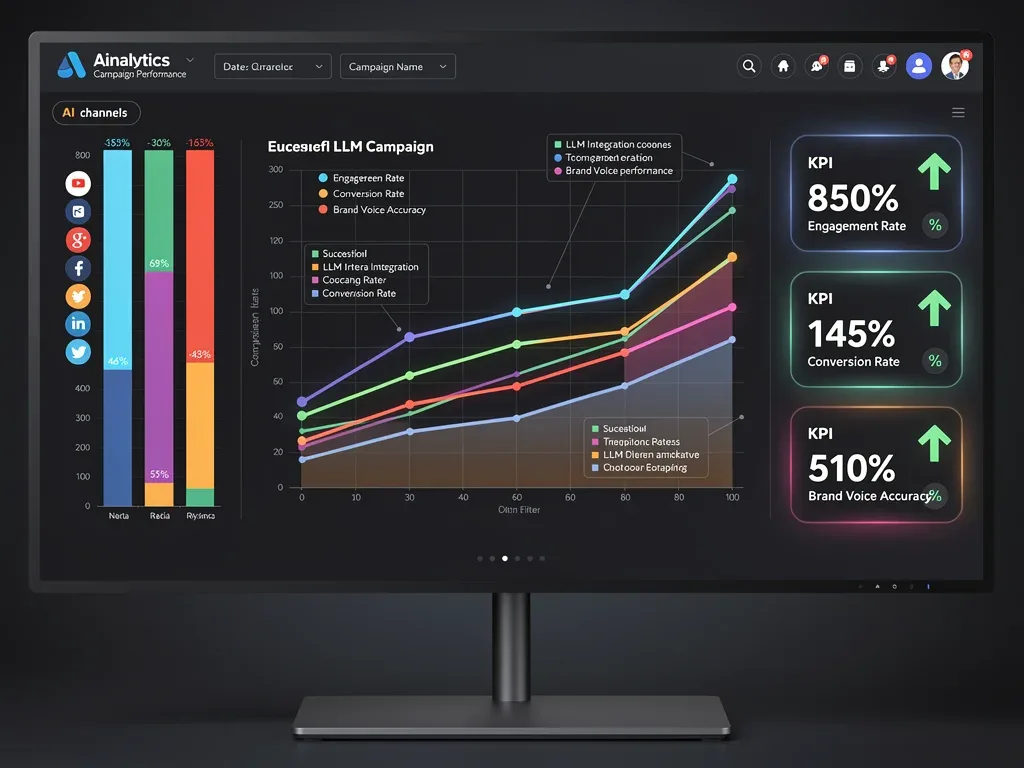
Before customizing an AI workflow, identify the characteristics that distinguish the brand's communication style from generic marketing language.
These characteristics may include sentence length, preferred vocabulary, degree of formality, emotional tone, humor, and approaches to calls to action.
A clear style guide provides a consistent reference for brand-specific LLMs for social media copy, helping writers and reviewers evaluate whether generated material follows the intended identity.
Voice Attributes: Define characteristics such as friendly, authoritative, informative, or energetic.
Vocabulary: Identify preferred words, terminology, and prohibited expressions.
Sentence Structure: Specify preferred length, complexity, and readability.
Audience: Describe the intended readers and their information needs.
Examples: Include approved content demonstrating appropriate language.
Turning Brand Identity Into Writing Instructions
Broad instructions such as "sound professional" may produce inconsistent results because different writers and models can interpret them differently.
More useful guidance describes observable writing choices, including terminology, paragraph length, message structure, and acceptable promotional language.
For brand-specific LLMs for social media copy, clear examples can demonstrate how abstract identity traits translate into practical captions and advertisements.
Data Curation: Building a Reliable Brand Content Library
High-quality examples help AI systems understand how an organization communicates with different audiences and across different platforms.
Useful source material may include approved social media posts, website copy, email campaigns, product descriptions, and other authorized marketing content.
When preparing brand-specific LLMs for social media copy, relevance and consistency are generally more valuable than collecting large quantities of unreviewed material.
The Role of Proprietary Data
Historical brand content can reveal recurring vocabulary, messaging patterns, formatting preferences, and approaches to different campaign objectives.
However, existing content may also contain outdated claims, inconsistent language, unsuccessful campaigns, or information that should not be reused.
Teams should curate examples carefully and verify that they represent the brand's current communication strategy before incorporating them into an AI workflow.
Creating a High-Quality Example Dataset
Begin by collecting approved examples covering different social platforms, campaign types, and target audiences.
Remove duplicate material, identify outdated information, and exclude content that conflicts with current brand guidelines.
For brand-specific LLMs for social media copy, a smaller collection of accurate, representative examples may provide a more useful starting point than an extensive but inconsistent dataset.
Approved Posts: Include content that reflects the intended voice.
Campaign Context: Record audience, platform, objective, and product information.
Quality Control: Remove factual errors and outdated promotional claims.
Data Permissions: Confirm that content can be used for the intended AI workflow.
Separating Training Data From Evaluation Data
Organizations need examples for guiding model behavior and a separate collection for measuring output quality.
If the same examples are used for customization and final evaluation, the resulting accuracy estimate may overstate performance on unfamiliar tasks.
A representative holdout set allows teams to evaluate whether brand-specific LLMs for social media copy maintain consistency across new campaigns and communication scenarios.
Prompt Engineering and Fine-Tuning for Brand Consistency
Customizing an LLM does not always require changing the model's underlying parameters through additional training.
Many organizations can begin with structured prompts, style instructions, approved examples, and relevant content supplied at generation time.
Fine-tuning may be appropriate for some compatible models and use cases, but it should be evaluated against simpler methods before committing to additional costs.
Starting With Prompt Engineering
A structured prompt should describe the brand's identity, intended audience, content objective, platform requirements, and writing restrictions.
Providing examples of successful approved copy can help the model understand the expected format and communication style.
For brand-specific LLMs for social media copy, prompt engineering can provide a practical baseline against which more advanced customization methods are measured.
When Fine-Tuning May Be Appropriate
Fine-tuning adapts a compatible pretrained model using examples intended to reinforce particular output patterns or behaviors.
It may be useful when a team has a substantial volume of consistent examples and repeated problems that are not adequately addressed through prompting.
However, fine-tuning availability, supported models, costs, and technical requirements depend on the provider. Organizations should confirm current capabilities before designing a training strategy.
Iterative Refinement With Human Feedback
Brand managers and experienced copywriters should review generated content for tone, factual accuracy, clarity, and audience suitability.
Reviewers can identify recurring weaknesses, document corrections, and use those findings to improve instructions or examples.
For brand-specific LLMs for social media copy, this process creates a useful feedback cycle without requiring every correction to become a formal model-training operation.
How to Measure Brand Voice Accuracy
Brand voice accuracy is not a universally standardized measurement with one accepted formula across the marketing industry.
Organizations therefore need to define their own evaluation criteria and explain what a reported percentage actually represents.
When discussing brand-specific LLMs for social media copy, a score such as 94% should be treated as an internal benchmark unless independent methodology and results are available.
Creating a Brand Voice Scorecard
A practical evaluation framework can assess several characteristics of generated copy, including tone, vocabulary, consistency, clarity, and compliance with approved messaging.
Each characteristic should have a documented scoring method and examples of acceptable and unacceptable outputs.
Using the same scorecard across multiple evaluations makes results easier to compare and helps identify where improvements are needed.
Tone Consistency: Does the writing reflect the defined brand personality?
Terminology: Does the copy use approved product names and vocabulary?
Message Accuracy: Are promotional statements supported by reliable information?
Audience Fit: Does the language match the intended readers?
Platform Compliance: Does the content follow relevant advertising and platform rules?
What Would 94% Voice Accuracy Actually Mean?
Suppose a marketing team evaluates 100 generated posts using predefined criteria and trained human reviewers.
If 94 posts satisfy the team's complete acceptance requirements, the organization could report a 94% pass rate for that particular evaluation.
However, this illustrative result would not establish universal brand-specific LLMs for social media copy accuracy, nor would it prove that the accepted posts generate more sales or engagement.
Improving Evaluation Reliability
Use multiple reviewers when practical, particularly for subjective characteristics such as tone and emotional resonance.
Compare reviewer judgments and clarify scoring criteria when disagreement occurs.
For meaningful performance tracking, test varied platforms, campaign objectives, audience segments, and content formats instead of evaluating only easy or familiar examples.
Measuring and Optimizing Conversion Performance
Consistent brand language does not automatically produce higher conversion rates, even when generated content receives strong editorial scores.
Marketing effectiveness depends on audience relevance, creative presentation, offers, distribution, landing pages, and other campaign factors.
For brand-specific LLMs for social media copy, brand consistency and business performance should therefore be measured separately.
A/B Testing AI-Generated Copy
Controlled experiments can help marketers compare content variants under conditions designed to minimize differences unrelated to the copy itself.
For example, teams might test one approved AI-assisted caption against a human-written version while maintaining comparable targeting, placement, and measurement settings.
Systematic A/B testing is useful for evaluating AI-generated social copy, but results should be interpreted in light of sample size, statistical uncertainty, and campaign objectives.
Click-Through Rate: Measures the share of impressions resulting in clicks.
Conversion Rate: Measures the proportion of relevant visits or interactions completing a defined action.
Engagement: Tracks meaningful interactions according to the platform.
Cost per Result: Helps assess campaign efficiency.
Quality Review: Identifies misleading, inconsistent, or noncompliant messaging.
Separating Brand Voice From Conversion Results
A post can follow every brand guideline and still perform poorly because it reaches the wrong audience or presents an unattractive offer.
Conversely, a highly engaging message may use language that does not fully match the organization's established identity.
Teams should evaluate both dimensions before deciding whether brand-specific LLMs for social media copy are meeting editorial and commercial expectations.
Using Campaign Feedback Responsibly
Performance data can help identify messaging patterns worth testing again, but high engagement does not necessarily indicate factual accuracy or customer trust.
Marketers should avoid optimizing exclusively for clicks when doing so encourages exaggerated claims or misleading impressions.
Human review remains important when interpreting outcomes and deciding which improvements should inform future AI-generated content.
Scaling Content Production With Brand-Specific LLMs
AI-assisted writing can reduce the effort required to produce initial drafts, variations, and platform-specific adaptations.
For teams managing several social channels, brand-specific LLMs for social media copy can help create a repeatable process for generating and reviewing content.
However, increased output volume should be balanced with editorial capacity, campaign relevance, and quality assurance.
Operational Efficiency and Cost Savings
Automation may reduce drafting time for recurring tasks such as promotional captions, event announcements, and content adaptations.
Actual savings depend on software expenses, review workload, integration costs, and the quality of generated material.
Organizations should measure time spent on drafting, editing, approvals, and corrections rather than assuming that AI adoption automatically reduces total marketing costs.
Maintaining Quality Across Multiple Platforms
Different social networks use different content formats, length limits, and communication conventions.
A consistent brand voice should allow appropriate adaptation rather than forcing identical wording into every platform.
For brand-specific LLMs for social media copy, platform-specific instructions can support relevance while preserving recognizable brand characteristics.
Building an Editorial Approval Workflow
A practical content workflow begins with a campaign brief and proceeds through AI-assisted drafting, editorial checks, factual verification, and approval.
High-risk claims, regulated topics, and sensitive promotional messages may require additional specialist review.
Publishing responsibility should remain clearly assigned to authorized team members, even when much of the initial text is produced automatically.
Addressing Ethical Considerations and Bias
Generative AI can reproduce stereotypes, create unsupported statements, or generate messages that are inappropriate for certain audiences.
Brands should assess these risks before publishing AI-assisted advertisements, particularly when content involves sensitive topics or important consumer decisions.
Responsible deployment of brand-specific LLMs for social media copy requires safeguards that extend beyond matching tone and formatting preferences.
Ensuring Fair and Inclusive AI Outputs
Marketing teams can review generated language for stereotypes, exclusionary expressions, and assumptions about audience characteristics.
Evaluation examples should represent realistic communication contexts and different audience needs.
When problematic patterns emerge, teams should investigate their source and revise relevant instructions, examples, or approval processes.
Verifying Claims and Preventing Misleading Copy
AI-generated marketing language may contain unsupported statistics, inaccurate product descriptions, or promises not supported by the actual offering.
Every factual promotional claim should be checked against reliable, current information before publication.
For brand-specific LLMs for social media copy, a compelling message is only useful when its statements remain accurate and consistent with applicable advertising requirements.
Future Trends in AI-Powered Social Copy
AI tools are evolving to support more content types, including combinations of written language, images, audio, and video.
These capabilities may give marketing teams more ways to adapt approved messaging across channels and campaign formats.
However, future performance gains should be assessed through practical evaluations rather than treated as guaranteed improvements in engagement or conversion.
Adaptive Learning and Real-Time Optimization
Marketing systems may increasingly combine AI-generated content with campaign analytics to recommend new messages and creative variations.
Such workflows can support experimentation, but automatically changing content based on live metrics introduces risks involving consistency, approval, and measurement quality.
For brand-specific LLMs for social media copy, the most reliable approach is to define clear evaluation and authorization requirements before allowing automated updates.
Multimodal Content and Brand Consistency
Brands may use AI tools to coordinate text, imagery, and video concepts under the same communication guidelines.
Consistency across formats requires more than matching vocabulary because visual identity, accessibility, messaging accuracy, and platform specifications also matter.
Organizations should establish separate quality checks for each medium while maintaining shared campaign objectives.
Challenges and Solutions in LLM Deployment
Deploying brand-specific LLMs for social media copy requires coordination between marketing, technical, legal, and information security teams.
Common difficulties include inconsistent input data, unclear editorial ownership, integration costs, and the need to protect confidential information.
Starting with a limited pilot can help teams identify operational problems before expanding the workflow across additional brands or platforms.
Securing Data and Ensuring Compliance
Brand content libraries may contain confidential campaign plans, proprietary materials, unpublished offers, or personal information.
Organizations should establish appropriate access controls, retention practices, vendor assessments, and data handling policies before sharing such material with an AI service.
Applicable privacy obligations may include the European GDPR, California privacy laws, or other regulations depending on the organization and its processing activities.
Training Marketing Teams to Use AI Effectively
Employees need practical guidance on writing structured prompts, reviewing generated material, and identifying unsupported claims.
Training should also cover when information must be checked with a product specialist or reviewed by legal and compliance teams.
With clear responsibilities, brand-specific LLMs for social media copy can become part of a controlled editorial process rather than an uncontrolled source of automated publishing.
Choosing Between Prompting, Retrieval, and Fine-Tuning
Prompting uses instructions and examples supplied during generation, while retrieval-based approaches provide relevant information from an approved content library.
Fine-tuning adapts a compatible model using structured examples when that capability is supported by the provider.
The appropriate method depends on the problem being solved, available resources, technical support, and results from representative evaluations.
A Practical Workflow for Brand-Specific LLMs
Organizations can develop a brand-focused AI writing workflow through manageable stages without immediately investing in custom model training.
Begin with a brand style guide, collect approved examples, create an evaluation set, and test a repeatable prompting process.
For brand-specific LLMs for social media copy, the objective is to establish measurable improvements before expanding automation or customization.
Step 1: Define the Voice and Campaign Objectives
Document the desired tone, approved terminology, audience expectations, and messaging restrictions.
Separate general brand requirements from campaign-specific instructions such as product details, promotional objectives, and calls to action.
Include representative examples so reviewers and AI systems can interpret the guidelines consistently.
Step 2: Establish an Evaluation Baseline
Generate a collection of sample posts using the initial instructions and evaluate them against a documented scorecard.
Record the results for tone consistency, factual correctness, audience suitability, and platform compliance.
This baseline helps establish whether subsequent changes to brand-specific LLMs for social media copy produce meaningful improvements.
Step 3: Improve and Retest
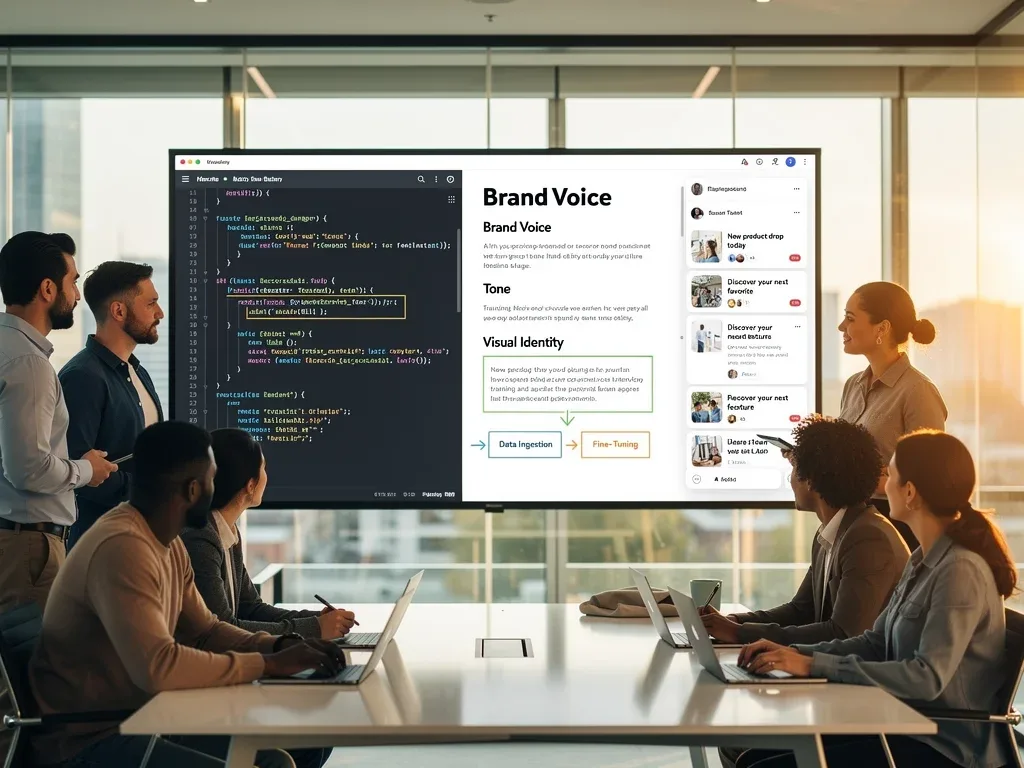
Review unsuccessful examples to identify specific problems such as inconsistent terminology, inappropriate tone, or weak calls to action.
Revise prompts, examples, or workflow controls and then repeat the evaluation on representative material.
Once editorial performance is acceptable, use appropriately designed campaign experiments to investigate whether the generated copy also improves business outcomes.
Conclusion
Brand-specific LLMs for social media copy can support consistent marketing communication when organizations combine clear guidance, approved examples, meaningful evaluations, and human oversight.
Accuracy claims such as 94% must be supported by a transparent testing process and should not be confused with guaranteed increases in conversions or revenue.
By beginning with measurable editorial requirements and refining workflows through feedback, brands can use AI more responsibly while maintaining control over their communication identity.
Key Point | Brief Description |
|---|---|
Brand Voice Definition | Document tone, vocabulary, audience expectations, and examples in an actionable style guide. |
Proprietary Data Curation | Use approved, representative, and appropriately authorized brand content. |
Iterative Fine-Tuning | Begin with prompting and evaluations; consider fine-tuning when supported and justified by measured needs. |
Ethical AI Deployment | Check factual claims, assess bias, protect sensitive data, and maintain human editorial approval. |
Frequently Asked Questions About Brand-Specific LLMs
What is a brand-specific LLM?▼
A brand-specific LLM is an AI language model or application configured to produce content aligned with an organization's communication guidelines. Customization may involve structured prompts, approved examples, retrieval from a content library, or fine-tuning when supported. It does not necessarily require training a new model from scratch.
How is 94% voice accuracy achieved?▼
There is no universally guaranteed 94% brand voice accuracy. A company would need to define measurable criteria, evaluate a representative sample, and document how reviewers scored the outputs. For example, a 94% acceptance rate might mean 94 of 100 evaluated posts met predefined requirements, but such a result would apply only to that particular evaluation.
Can LLMs truly generate high-converting social copy?▼
LLMs can help create persuasive drafts and useful creative variations, but higher conversion rates are not automatic. Marketers must test content in real campaigns, monitor relevant metrics, and account for factors such as audience targeting, offers, landing pages, and creative presentation. Brand voice consistency and conversion performance should be evaluated separately.
What data is needed to train a brand-specific LLM?▼
Useful data can include approved social posts, product descriptions, marketing emails, website copy, and documented brand guidelines. The examples should be relevant, accurate, current, and authorized for the intended use. Depending on the technical approach, these materials may support prompting or retrieval without requiring additional model training.
What are the ethical concerns with AI-generated content?▼
Important concerns include inaccurate claims, bias, misleading promotional language, privacy risks, and the use of confidential materials without appropriate controls. Organizations should verify factual information, follow applicable advertising and privacy requirements, and retain human oversight. Transparent processes help make AI-assisted marketing more accountable.
Looking Ahead
The development of brand-specific LLMs for social media copy offers opportunities to improve content workflows through structured guidance, automation, and systematic evaluation.
Businesses can also explore AI-assisted social media automation, while keeping expectations grounded in measured performance rather than unsupported engagement or accuracy claims.
As technology evolves, successful adoption will depend on maintaining accurate brand information, protecting sensitive data, and using real campaign evidence to guide improvements.