Synthetic Focus Groups: Replacing Human Panels? Accuracy Across 1,200 Ads
Advertisements
Synthetic focus groups are becoming a serious market-research tool in 2026, but current evidence does not support treating AI-generated consumers as universal replacements for human panels.
Large language models can generate rapid reactions to concepts, survey questions and positioning ideas, making them attractive for early screening and iterative research.
The strongest results appear when synthetic responses are calibrated against real human data and used alongside traditional research rather than accepted as standalone consumer truth.
What Are Synthetic Focus Groups?
Synthetic focus groups use artificial intelligence to generate consumer-like responses without recruiting a new group of human participants for every research question.
The systems may be prompted with demographic information, behavioral data, previous survey responses or richer individual profiles intended to represent particular types of consumers.
They can then evaluate concepts, answer questionnaires or simulate discussions, giving researchers large volumes of feedback at comparatively high speed.
Synthetic Respondents Are Not Actual Consumers
A synthetic respondent is a model-generated representation of how a person or consumer segment might answer a question under specified conditions.
Even when responses sound natural and internally coherent, they remain predictions generated from model training, prompts and any external data supplied to the system.
This distinction matters because plausible language can create an impression of genuine consumer understanding even when the underlying distribution differs from real people.
Different Synthetic Methods Should Not Be Treated as Equivalent
An ungrounded chatbot instructed to “act like a 35-year-old shopper” is fundamentally different from a model calibrated against extensive historical customer research.
More sophisticated approaches may use survey histories, behavioral information or individual-level profiles to constrain the synthetic responses they generate.
Accuracy claims therefore mean little unless researchers explain what information the model received, how outputs were calibrated and what human benchmark was used.
The Claimed 1,200-Ad Study Cannot Be Verified
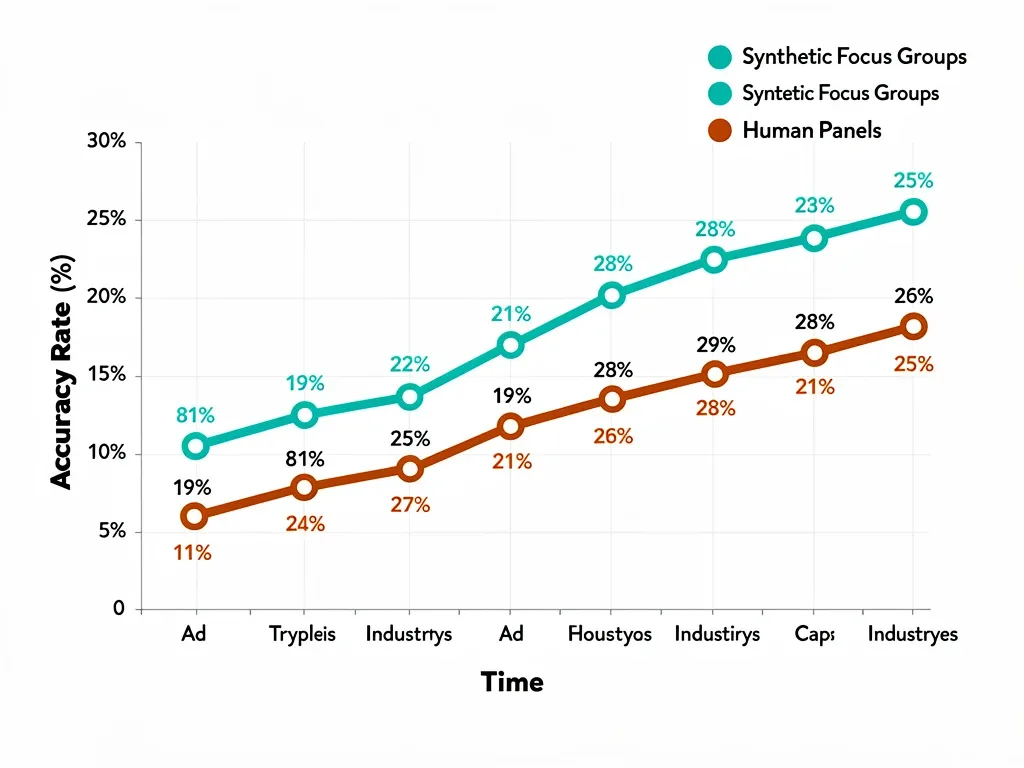
The idea that 1,200 advertising concepts were tested and synthetic panels achieved approximately 78% accuracy appears in some generated content without a traceable primary study.
A credible research claim should identify the researchers, sample, stimuli, models, human comparison group, accuracy definition and publication or working paper supporting the result.
Without those elements, marketers should not repeat a precise percentage simply because it sounds consistent with broader enthusiasm around synthetic research.
Accuracy Needs a Clear Definition
Accuracy could mean selecting the same preferred concept as humans, predicting an average rating or reproducing individual responses, and those are very different tests.
A model can approximate population averages while still failing to reproduce variation, minority preferences or the relationships between attitudes across individual consumers.
For that reason, one headline percentage can conceal substantial weaknesses unless the exact outcome and unit of analysis are reported.
Aggregate Agreement Can Be Misleading
If most consumers mildly prefer one concept, a synthetic sample can reproduce the average while assigning unrealistically similar preferences to almost every simulated person.
This may look successful on a mean score but fail badly when marketers need segmentation, heterogeneity or reliable predictions for specific subgroups.
Modern validation therefore increasingly examines distributions, correlations and individual-level correspondence instead of asking only whether averages look similar.
What 2026 Research Actually Shows
Research published during 2026 paints a mixed picture rather than demonstrating that AI can reliably substitute for human market-research participants.
Several studies find that synthetic respondents can reproduce portions of aggregate human behavior while struggling with individual differences, cultural variation and complex relationships.
The emerging consensus is not that the technology is useless, but that reliability depends heavily on task, calibration, population and evaluation method.
Large Cross-Country Evidence Shows Important Limits
A major 2026 study simulated economic preferences for tens of thousands of matched participants across 74 countries using multiple language-model configurations.
The synthetic responses recovered some individual and demographic patterns but were substantially weaker at reproducing cultural differences across countries.
The researchers concluded that LLM simulations were not yet reliable substitutes for representative human surveys in macro-level inference or policy evaluation.
Participant-Matched Personas Still Miss Individual Differences
Another 2026 study matched AI personas to real participants and evaluated responses across 91 psychological constructs instead of relying on simple plausibility tests.
Providing personality information improved some results, particularly distributional similarity, but individual-level correspondence with actual participants remained modest.
This demonstrates why increasingly detailed persona prompts cannot automatically transform an LLM into a faithful digital duplicate of a real respondent.
Synthetic-Only Research Can Introduce Large Bias
One of the most important lessons from current research is that increasing the number of simulated respondents does not automatically eliminate systematic model error.
If an LLM consistently interprets an issue differently from humans, generating thousands of additional synthetic responses can reproduce the same error more confidently.
This makes calibration and validation more important than simply increasing the synthetic sample size or switching to a more capable frontier model.
Human Calibration Can Improve Results Dramatically
Research presented at ACL 2026 found substantial bias when LLM-generated survey responses were used without correction across several survey domains.
When a limited quantity of real human data was reserved for statistical rectification, the resulting population estimates became considerably more accurate.
This supports a hybrid model in which inexpensive synthetic responses expand coverage while real observations anchor estimates to actual human behavior.
More Powerful Models Do Not Guarantee Human Fidelity
Benchmark research has found cases where increasing model capability did not resolve distorted demographic relationships or failures to reproduce human variation.
An advanced model may produce more articulate explanations while still representing consumer segments too stereotypically or overestimating differences between demographic groups.
Researchers should therefore validate each use case rather than assuming model intelligence and respondent validity increase at exactly the same rate.
Where Synthetic Focus Groups Can Be Useful
The technology is most compelling in research stages where speed, exploration and breadth matter more than final population-level inference.
Teams can use synthetic responses to pressure-test questionnaires, identify obvious concept problems and generate hypotheses before spending money on larger human studies.
This aligns with longstanding research guidance that sees silicon samples as particularly promising for upstream qualitative pretesting and pilot work.
Early Concept Screening Is a Strong Use Case
A creative team may have 50 headlines, package ideas or positioning statements but only enough budget to test a small subset with consumers.
Synthetic evaluation can help flag repetitive, unclear or obviously weak options before researchers select a more manageable group for human validation.
This makes AI valuable as a filtering mechanism without requiring the organization to believe that its ranking represents final market demand.
Questionnaire Pretesting Can Become Faster
Researchers can expose draft questions to multiple synthetic personas to identify ambiguous wording, confusing response options or obvious interpretation problems.
These simulations cannot prove that real respondents will interpret every question correctly, but they can reveal issues before an expensive survey is fielded.
The approach is especially useful when AI operates as a design assistant rather than pretending to provide representative consumer measurements.
Advertising Concept Testing Requires Realistic Benchmarks
Ad testing presents a difficult validation problem because successful advertising involves attention, memory, emotion, persuasion, brand context and eventual marketplace behavior.
A synthetic respondent may explain why a commercial appears persuasive without accurately predicting whether real viewers will remember or act on it.
Any serious advertising benchmark should therefore compare AI predictions against human responses and, when possible, observed campaign outcomes rather than researcher intuition alone.
Concept Preference Is Easier Than Market Prediction
Selecting which of several concepts appears clearer or more appealing is a narrower task than forecasting incremental sales or long-term brand effects.
Synthetic systems may become useful for the first task while remaining unreliable for the second, despite both being described loosely as “ad effectiveness.”
Marketers should match the confidence they place in synthetic evidence to the specific decision being made and the cost of being wrong.
Radically New Concepts Are Particularly Difficult
Models trained largely on existing language and historical cultural patterns may perform best when evaluating concepts similar to situations represented in prior data.
Truly novel products, unfamiliar creative formats and emerging cultural behavior provide less historical structure from which a synthetic consumer can generate reliable predictions.
Human exploration remains especially important when the purpose of research is discovering reactions that the organization did not already know to anticipate.
Speed Is a Genuine Advantage
Synthetic research can evaluate many stimuli quickly because additional simulated respondents do not require individual recruitment, scheduling or incentive payments.
This enables teams to explore more creative variations before committing resources to human testing and production.
The advantage becomes particularly valuable when marketers treat speed as a way to increase experimentation rather than as justification for eliminating validation.
Low Marginal Cost Changes Research Workflows
Traditional panels incur additional recruitment and fieldwork costs as sample size, segmentation and geographic coverage increase.
Once a synthetic system is configured, generating additional model responses can be comparatively inexpensive, allowing teams to examine many more scenarios.
However, low cost can encourage excessive testing, so organizations still need clear hypotheses and decision criteria rather than generating endless artificial feedback.
Global Simulation Does Not Guarantee Global Representation
An AI model can instantly produce responses attributed to consumers from dozens of countries, but geographic labeling alone does not establish cultural validity.
Recent cross-national evidence shows that synthetic responses can be considerably weaker at reproducing cultural differences than simpler demographic relationships.
International marketers should therefore validate important local decisions with real participants from the markets they are trying to understand.
AI Does Not Automatically Remove Human Bias
A common argument for synthetic research is that AI eliminates researcher bias, but this presents the technology as more neutral than it actually is.
Models can inherit patterns from training data, reinforcement processes, prompting choices and the assumptions researchers use when constructing synthetic personas.
Bias can therefore shift location rather than disappear, becoming embedded inside a system whose answers appear consistent and quantitatively precise.
Synthetic Personas Can Amplify Demographic Stereotypes
Research has found that models sometimes treat age, gender, education or cultural labels as more predictive of opinions than those characteristics are among humans.
This can make synthetic segments appear more distinct and internally homogeneous than real-world consumers actually are.
Using such outputs for targeting could cause marketers to exaggerate demographic differences and overlook people whose preferences do not follow familiar stereotypes.
Consistency Is Not the Same as Objectivity
An AI system can apply the same procedure repeatedly, which is valuable for operational consistency and reproducibility.
That consistency does not demonstrate that the underlying procedure is unbiased, representative or causally related to real consumer decisions.
Researchers still need external validation, sensitivity testing and transparent documentation of prompts, models, datasets and calibration procedures.
Human Panels Have Their Own Limitations
The weaknesses of synthetic respondents should not create the impression that conventional consumer research provides perfect ground truth.
Human surveys face sampling error, nonresponse, panel conditioning, social desirability, poor attention and difficulties recruiting representative populations at reasonable cost.
The relevant comparison is therefore not perfect humans versus flawed AI, but whether each method produces sufficiently trustworthy evidence for a particular decision.
Focus Groups Are Especially Interpretive
Traditional focus groups contain relatively few participants and are generally intended to explore language, motivations and reactions rather than estimate population percentages.
Group dynamics, moderator behavior and dominant participants can influence what gets discussed and how strongly certain views appear.
Synthetic tools may help researchers challenge interpretations, but they do not solve the fundamental need to understand how actual people construct meaning together.
Human Research Should Also Be Validated Carefully
Survey panels should be examined for sample quality, weighting, attention and recruitment practices instead of receiving automatic trust simply because respondents are human.
Concept-testing systems should demonstrate relationships between their metrics and meaningful outcomes before organizations use them for expensive business decisions.
A rigorous hybrid framework can improve both sides by forcing AI and conventional research to meet explicit validation standards.
The Best 2026 Strategy Is Hybrid Research
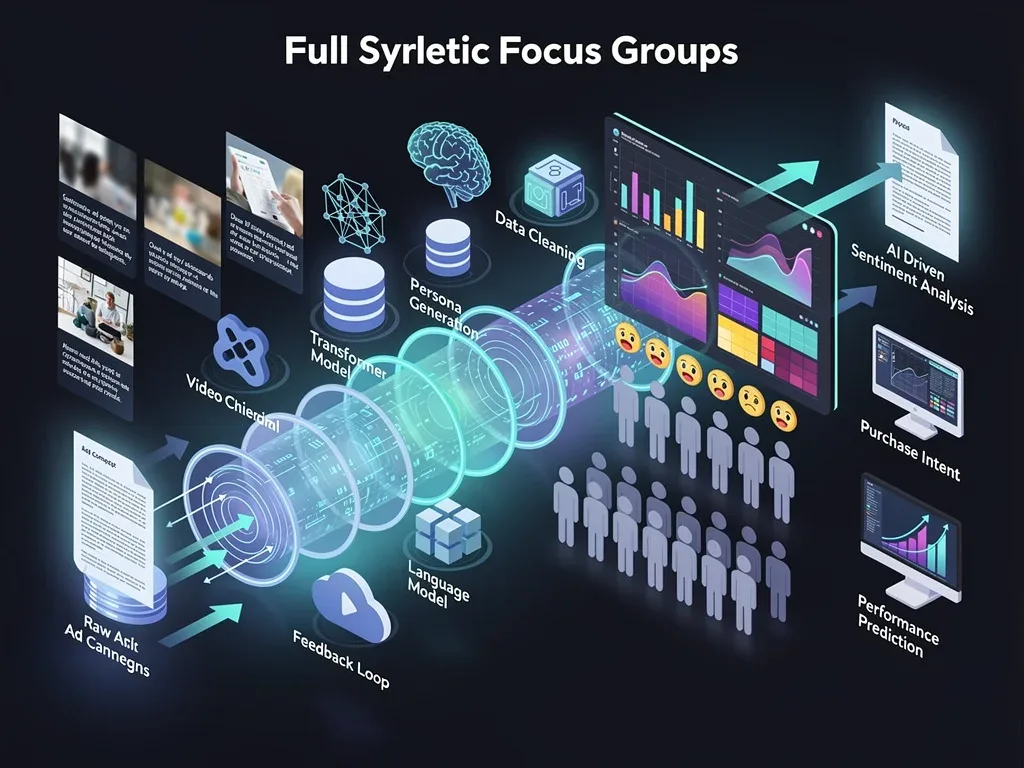
Current evidence favors using synthetic respondents as an augmentation layer rather than replacing the human evidence base entirely.
AI can generate inexpensive preliminary signals while a smaller human sample provides calibration, validation and insight into unexpected reactions.
This architecture can preserve much of the speed advantage while reducing the risk of treating model-generated patterns as direct observations of consumers.
Use AI First for Breadth
At the beginning of a project, synthetic participants can review numerous concepts, identify potential issues and help refine research questions.
This broad screening allows researchers to allocate human sample budgets toward the decisions that remain most uncertain or strategically important.
It also encourages teams to explore more hypotheses without presenting every synthetic result as a statistically representative consumer finding.
Use Humans for Calibration and Discovery
Human participants should test whether synthetic rankings, segment differences and explanations actually appear in the intended population.
Open-ended interviews remain valuable because real people can introduce concerns, associations and language that researchers never thought to include in a prompt.
This discovery role is difficult to replace when innovation depends precisely on learning something outside existing assumptions and historical patterns.
Calibration Matters More Than Synthetic Sample Size
Generating 100,000 model responses cannot repair a systematic distortion if they all originate from the same biased response-generating process.
Researchers increasingly use human observations to estimate where synthetic answers diverge and then statistically correct the artificial sample.
This turns synthetic data into an auxiliary measurement source rather than pretending each generated persona carries the same evidentiary weight as a human participant.
Recent Simulations Support Governed Calibration
A 2026 market-testing framework showed that calibrated hybrid designs could outperform synthetic-only estimates under its simulated campaign conditions.
The authors intentionally describe synthetic personas as potentially biased measurement signals and emphasize that their numerical results are scenario-specific rather than universal benchmarks.
This is a more defensible approach than advertising one accuracy percentage as proof that synthetic consumers can replace traditional research everywhere.
Real-World Validation Is Still Necessary
Simulation studies can demonstrate that a statistical method works under controlled assumptions without proving identical performance in live consumer environments.
Models should ultimately be compared against real respondents and meaningful downstream outcomes such as purchase, recall or market behavior where appropriate.
Without external validation, apparent predictive success can reflect assumptions built into the benchmark rather than genuine consumer fidelity.
Businesses Are Already Experimenting With Synthetic Panels
Consultancies, research companies and consumer brands are exploring synthetic panels for concept development, pricing and other innovation decisions.
Some proprietary deployments report high predictive performance after systems are trained or calibrated against historical consumer evidence.
Those case studies show commercial potential but should not be generalized automatically to every model, industry, geography or research question.
High Accuracy Claims Need Context
A reported business test may achieve strong agreement because the model has access to years of company-specific research and similar historical decisions.
A generic language model receiving only a demographic prompt is solving a much harder task and should not be expected to reproduce those results.
Marketers evaluating vendors should ask exactly what human data anchors the system and whether accuracy has been independently measured on new decisions.
Research Governance Becomes Essential
Organizations need internal standards that determine which decisions can rely on synthetic evidence and which require direct human validation.
Low-risk brainstorming may justify lighter validation, whereas pricing, positioning or audience decisions involving substantial investment deserve stronger empirical controls.
A governance framework also makes it harder for teams to cherry-pick convenient synthetic answers simply because they support a preferred strategy.
Document Models, Prompts and Data Sources
Synthetic research can change when a model version, system instruction, temperature, persona description or underlying dataset changes.
Researchers should record those elements so an analysis can be reproduced, audited and compared with later model versions.
Teams exploring broader governance questions can also review these risks of unregulated AI development.
Privacy Still Matters Without a Live Focus Group
Synthetic respondents may not be real people, but the information used to construct them can originate from real customer records, surveys and transactions.
Individual-level digital twins raise particularly important questions when personal data is used to predict opinions that the person never explicitly provided.
Organizations should assess consent, access, retention and permitted use rather than assuming synthetic output eliminates privacy obligations around source data.
Digital Twins Require Stronger Controls
A persona created from broad public demographics poses different risks from a digital twin built from detailed behavioral and first-party customer information.
The richer the source profile becomes, the more important data minimization, security and governance are to the research process.
Companies should also distinguish internal exploratory modeling from decisions that directly affect an identifiable customer's treatment or opportunities.
AI Can Support Research Without Pretending to Be Human
Some of the most valuable applications do not require claiming that a generated persona faithfully represents a specific human consumer.
Models can summarize previous research, identify contradictions, generate hypotheses and help researchers design better questions before new participants are recruited.
These functions use AI as an analytical assistant rather than asking it to manufacture evidence that appears to come from real respondents.
Research Assistance May Be Lower Risk Than Substitution
An AI system can rapidly organize thousands of prior interview comments or suggest dimensions that deserve additional testing in the next study.
The researcher can then verify those ideas with actual consumers rather than assigning population-level meaning to generated responses.
Similar augmentation patterns are appearing across other industries as organizations explore AI-driven operational transformation.
Synthetic Panels Should Be Tested Locally
A model that performs well for one category, segment or question type may fail when transferred to another without recalibration.
Recent methodological work argues that validity should be evaluated at the specific item, attribute or segment where the business decision actually depends.
This local perspective is more useful than reporting one overall study score that averages strong predictions together with severe failures.
Test the Cells That Matter to the Decision
If a campaign depends primarily on reactions among young first-time buyers, synthetic validity for that segment matters more than the overall sample average.
Likewise, correct prediction of brand preference offers little reassurance when the actual decision concerns willingness to pay or reaction to controversial humor.
Validation design should therefore follow the managerial decision rather than using whichever global accuracy metric makes the model look strongest.
Do Not Treat Synthetic Segments as Census Data
LLMs can generate thousands of apparent consumers across ages, regions, incomes and lifestyles, creating an impression of population-level representativeness.
But persona counts are generated by researchers rather than sampled from society, and model responses can systematically flatten genuine human diversity.
A synthetic sample becomes representative only through demonstrated calibration and validation, not because its spreadsheet contains realistic-looking demographic proportions.
Minority Opinions Are Especially Important to Validate
Models optimized for plausible responses may converge toward common narratives and underrepresent uncommon, contradictory or socially uncomfortable viewpoints.
Those minority responses can be precisely what reveals product problems, misunderstood positioning or emerging cultural changes before they become mainstream.
Human qualitative research remains valuable because unusual responses can be investigated rather than automatically smoothed toward an artificial consensus.
Innovation Funding Will Accelerate the Technology
AI research continues advancing rapidly, meaning current limitations should not be interpreted as permanent boundaries on synthetic consumer systems.
Better retrieval, multimodal models, calibrated digital twins and improved statistical correction may continue raising performance across particular research tasks.
Organizations following the ecosystem can monitor broader developments in U.S. AI research and innovation funding while independently validating marketing applications.
Improvement Does Not Eliminate the Need for Benchmarking
A future model may outperform today's systems but still require testing against consumers whenever prompts, products or populations change.
Continuous benchmarking is especially important because proprietary models can be updated without researchers controlling every change in internal behavior.
The appropriate question is therefore not whether AI eventually becomes “good enough,” but how its validity will be demonstrated for each decision.
Synthetic Focus Groups and Marketing Strategy
Marketers should view synthetic research as one component of a broader evidence system that also includes experiments, behavioral data and human consumer research.
No single method reveals everything: behavioral data shows what people did, surveys capture reported attitudes and synthetic systems model possible responses.
The strongest strategic decisions combine evidence while remaining clear about which observations came from actual people and which were generated by models.
AI Can Accelerate Iteration
Creative teams can use synthetic respondents repeatedly during development instead of waiting until the end of the process for one expensive validation round.
This increases the number of hypotheses explored while allowing human testing to concentrate on finalists and high-risk questions.
That workflow fits a broader move toward AI-assisted marketing workflows without requiring human judgment to disappear.
When Human Research Remains Essential
Human validation becomes particularly important when decisions involve unfamiliar products, sensitive topics, cultural meaning or major financial commitments.
Real consumers can misunderstand a message, make unexpected associations or challenge assumptions in ways no researcher knew to encode into synthetic prompts.
Those surprises are not noise to eliminate; they are often the reason organizations conduct exploratory research in the first place.
Use Humans When the Cost of Error Is High
A minor headline experiment carries different consequences from a nationwide rebrand, major product launch or communication involving vulnerable populations.
As decision stakes rise, teams should demand stronger external validity and direct evidence from the people whose behavior the strategy aims to influence.
Automation can still support recruitment, analysis and research operations without replacing the underlying human evidence required for confidence.
Can Synthetic Focus Groups Replace Human Panels?
The best answer in 2026 is no—not as a universal replacement—but synthetic respondents can become valuable components of a carefully governed research process.
They are particularly useful for exploration, pretesting, screening and augmentation when their outputs are calibrated and interpreted within demonstrated limitations.
They become risky when generated responses are presented as observed consumer facts without transparent benchmarks against the relevant human population.
A Hybrid Model Is the Strongest Current Approach
Use synthetic research to expand the number of ideas explored, then use humans strategically to calibrate estimates and investigate important qualitative reactions.
Repeat validation whenever categories, consumer groups or research questions change instead of assuming earlier performance transfers automatically to new settings.
This model captures AI's speed advantage while preserving the human evidence needed to understand emotion, culture, novelty and unexpected consumer behavior.
Research Approach | Best Current Role |
|---|---|
Synthetic Respondents | Rapid screening, pretesting, hypothesis generation and scalable exploratory analysis. |
Human Surveys | Population measurement, calibration and validation when representative evidence is required. |
Human Focus Groups | Exploring language, motivations, cultural interpretation and unexpected reactions. |
Hybrid Research | Combining AI scale with human calibration for higher-confidence decisions. |
Synthetic-Only Decisions | Best limited to validated, lower-risk contexts where failure costs are understood. |
Frequently Asked Questions About Synthetic Focus Groups
What are synthetic focus groups?
They are AI-generated simulations designed to produce consumer-like feedback without recruiting a new human participant for every generated response.
Was there a verified study of 1,200 ad concepts showing 78% accuracy?
No reliable primary source supporting that specific study and accuracy figure was identified, so the claim should not be presented as established evidence.
Can synthetic focus groups replace human panels?
Current research does not support universal replacement. Synthetic respondents are better treated as complementary tools that require human validation for important decisions.
Are synthetic responses accurate?
Sometimes, depending on the task. They can reproduce certain aggregate patterns while performing poorly on individual differences, cultural variation or specific research cells.
Do synthetic panels eliminate bias?
No. Models can inherit biases from training data and prompting and may exaggerate demographic differences or produce overly homogeneous responses.
What is the strongest use case today?
Early-stage concept screening, survey pretesting, hypothesis generation and other exploratory tasks are among the most defensible applications.
Why does human calibration matter?
Real observations reveal where synthetic outputs systematically differ from consumers and can be used to correct or constrain model-generated estimates.
Are digital twins more reliable than simple personas?
They can contain richer individual information, but research still finds imperfect correspondence, and their additional personal data creates stronger privacy considerations.
Can synthetic panels test completely new products?
They can generate reactions, but radically novel products are particularly risky because historical model patterns may provide limited evidence about genuine future behavior.
What should marketers ask a synthetic-research vendor?
Ask what human data calibrates the system, which populations were validated, how accuracy is measured and how performance changes across segments and decisions.
Conclusion
Synthetic focus groups are a promising 2026 research technology, but evidence does not justify presenting them as validated replacements for human consumers.
The best-supported approach uses AI for speed and breadth while relying on real respondents for calibration, discovery and high-stakes validation.
Marketers should reject unsupported headline accuracy claims and instead demand transparent benchmarks showing exactly where synthetic evidence succeeds, where it fails and why.