Generative Product Photography: Retailers Cut Costs by 75%
Advertisements
Generative product photography is changing how retailers create catalog, advertising and social-media visuals by combining original product assets with AI-generated backgrounds, scenes and creative variations.
The technology can reduce dependence on repeated studio setups, props and manual editing, especially when brands need many versions of the same product image.
However, claims that retailers universally cut photography costs by 75% go beyond available evidence, making workflow-specific measurement more useful than one headline percentage.
What Generative Product Photography Actually Means
Generative product photography uses artificial intelligence to create or modify visual elements surrounding a product while attempting to preserve the characteristics of the item itself.
Depending on the workflow, teams can replace backgrounds, modify lighting, build lifestyle environments, generate models or create new campaign compositions from existing source imagery.
This approach forms part of the wider adoption of artificial intelligence across creative and commercial operations.
AI Does Not Always Generate the Product From Scratch
Many retail workflows begin with a real photograph, transparent product cutout, supplier image or approved digital representation of the physical item.
The AI then generates environments or edits around that source instead of inventing every visual characteristic of the product independently.
This distinction can reduce the risk of accidentally changing important details such as shape, color, stitching, labels, hardware or packaging.
Product Image Generation Is Already Available to Merchants
AI-assisted product-image tools are no longer limited to experimental research because commercial e-commerce platforms increasingly include these capabilities directly in merchant workflows.
Retailers can use them to remove backgrounds, create studio-style environments and generate alternative lifestyle scenes without rebuilding every setup physically.
This accessibility lowers the technical barrier for smaller brands that previously needed separate photography, retouching and design resources for each campaign.
A Source Image Still Matters
A clear source image provides the system with a stronger reference for product proportions, edges, textures and other features that should remain consistent.
Poor lighting, blocked product details or low-resolution inputs can make generated outputs less reliable regardless of how sophisticated the AI model is.
Retail teams should therefore improve their base-product capture process rather than assuming generative AI removes the need for accurate source assets.
The 75% Cost-Saving Claim Needs Context
There is no credible basis for presenting a 75% reduction in studio costs as a standard result achieved across the retail industry.
Individual implementations can generate substantial savings, especially when repetitive catalog production previously involved expensive studios, logistics, retouching and physical sets.
The percentage ultimately depends on what a company previously spent and which portions of the workflow can realistically move to an AI-based production process.
Real Savings Should Be Calculated Per Workflow
A retailer should compare its previous all-in production cost per SKU or final usable asset against the complete cost of its AI-assisted workflow.
That comparison should include software, staff time, quality control, source photography, revisions and any traditional shoots that remain necessary.
Measuring only the AI subscription cost while ignoring human review would make the apparent savings look much larger than the actual business benefit.
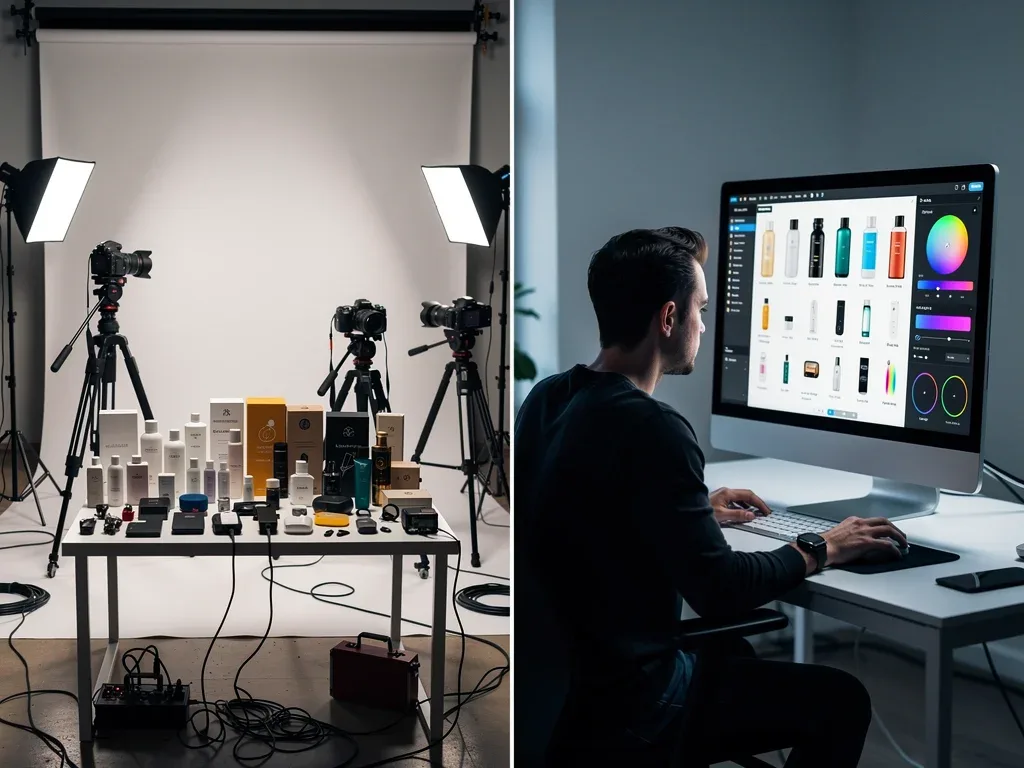
Where Generative AI Can Reduce Photography Costs
Traditional product production can require studio time, photographers, assistants, props, location preparation, sample shipping and extensive post-production before a final image goes live.
Generative workflows can eliminate or reduce some of those steps when the brand already possesses a trustworthy image of the actual product.
The largest efficiencies often appear in repetitive catalog and campaign variations rather than high-end creative shoots where physical production itself contributes to the brand aesthetic.
Background Production Is an Obvious Use Case
A single approved product cutout can potentially appear against multiple seasonal, geographic or stylistic backgrounds without constructing each environment physically.
This can reduce the need to buy props, build temporary sets or repeatedly photograph the same product solely because the surrounding scene changes.
Background generation is particularly useful when retailers need different compositions for product pages, advertisements, email campaigns and social channels.
AI Can Accelerate Catalog Production
Catalog photography becomes expensive when retailers manage hundreds or thousands of SKUs and need consistent visuals for each product variation.
Automated generation can process repetitive creative tasks faster and enable brands to produce several candidate assets from one approved source image.
The time saved becomes especially meaningful when products have short selling windows and delaying publication can reduce their commercial opportunity.
Speed to Market Can Matter as Much as Cost
A product that waits days or weeks for photography cannot begin generating online sales even when inventory is already available.
Reducing visual-production bottlenecks can allow merchandising teams to publish new products or refresh creative assets closer to changing consumer demand.
This operational flexibility is one reason generative visuals fit broader discussions about AI's impact on marketing workflows.
Generative Photography Makes Creative Testing Easier
Producing several traditional photo shoots simply to compare backgrounds or compositions can make experimentation expensive before marketers know which version performs best.
Generative AI can lower the production barrier by creating multiple visual concepts that marketers can test with real audiences.
The winning concepts can then receive additional refinement or traditional production investment when greater creative control is required.
A/B Testing Needs Clean Measurement
Marketers should avoid changing background, headline, audience, offer and placement simultaneously if they want to understand which visual actually improved results.
Structured testing allows teams to compare generated assets according to click-through rate, conversion rate or other metrics relevant to the campaign.
Performance data can then guide future image generation instead of relying exclusively on subjective opinions about which creative looks more attractive.
Personalization Becomes Easier to Scale
A retailer can potentially display the same product in different environments based on season, region, marketing channel or audience segment.
A furniture product might appear in several interior styles, while apparel could be presented through different campaign concepts built from approved source assets.
Creating that volume of variations with traditional production would normally require substantially more scheduling, physical sets and post-production work.
Personalization Still Needs Brand Controls
Generating unlimited visual variations is not useful when those assets stop looking like they came from the same retailer.
Brands need defined rules for composition, lighting, typography, product positioning and acceptable environmental styles across generated creative.
Reusable templates and human approval can help keep scalable personalization from turning into inconsistent visual communication.
Product Accuracy Is the Most Important Limitation
An attractive generated image can still be unsuitable for e-commerce if the AI modifies a physical characteristic of the item being sold.
Changes to color, proportions, pockets, buttons, textures or included accessories can create a mismatch between what customers see and what they receive.
Retail teams should prioritize faithful product representation over visual novelty when generated images appear directly on product-detail pages.
Small AI Errors Can Become Commercial Problems
A generated reflection might create hardware that does not exist, while an altered pattern can make clothing look different from the actual garment.
These mistakes may seem minor to a creative team but become significant when the image influences a customer's purchasing decision.
Every generated product asset should therefore pass a comparison against approved references before it is published.
Human Quality Control Remains Necessary
Generative tools can automate portions of visual production, but they cannot independently determine every commercial, legal or brand requirement relevant to an image.
Human reviewers still need to examine product fidelity, composition, inappropriate artifacts, brand consistency and whether the final visual accurately communicates the offer.
The most practical model is therefore AI-assisted production with human approval rather than uncontrolled publication of every generated output.
Teams Need New Skills Rather Than No Skills
The workflow shifts some effort away from physical production toward source preparation, prompting, image selection, editing and quality assurance.
Creative professionals also need to understand when a traditional photographer, 3D artist or retoucher can produce a more dependable result than generation alone.
AI changes where creative labor occurs rather than automatically eliminating the need for professional judgment.
Traditional Photography Still Has Important Advantages
High-end campaigns frequently depend on precise lighting, authentic human performances, detailed art direction and unusual sets that are difficult to control perfectly through generation.
Photography also creates a reliable visual record of the actual product when accurate color, texture and physical construction are essential.
Brands should therefore avoid treating generative imagery as a mandatory replacement for every conventional production method.
A Hybrid Workflow Is Often More Practical
A company might photograph hero campaign images traditionally while using AI to create additional catalog backgrounds, regional variants or social-media compositions.
This keeps physical photography focused on work where creative control matters most while automation handles more repetitive asset production.
Hybrid production can also reduce risk because generated assets remain anchored to verified imagery created from the real merchandise.
Fashion Requires Additional Accuracy Checks
Apparel and accessories contain small design details that can easily change when AI attempts to redraw garments on new backgrounds or generated models.
Patterns, logos, seams, closures and proportions should remain consistent because even small deviations can misrepresent the product offered for sale.
On-model generation therefore requires stricter approval than simply replacing the background behind an isolated product image.
Fit Should Not Be Invented Carelessly
A generated model can make a garment appear tighter, longer or differently proportioned than it actually fits on a person.
That difference can influence expectations about sizing and potentially increase dissatisfaction or returns when shoppers receive the physical item.
Brands using synthetic models should keep accurate measurements and conventional product information available alongside generated creative.
Furniture and Home Products Present Different Risks
Generated lifestyle scenes can help shoppers visualize furniture, appliances and décor inside rooms without requiring brands to construct multiple physical interiors.
However, AI can distort size relationships, dimensions or installation conditions when it does not preserve the scale of the source product accurately.
A beautiful room image should therefore never replace specifications, dimensions and other factual information required for an informed purchase.
Context Must Not Misrepresent Included Items
A generated scene may add decorative accessories or supporting objects that customers could mistakenly interpret as part of the product package.
Retailers should ensure descriptions and visual composition clearly distinguish the merchandise being sold from surrounding generated décor.
This becomes increasingly important as synthetic scenes become realistic enough that viewers cannot easily determine which objects existed in the source image.
AI Images Need Consistent Brand Governance
As generation becomes easier, retailers may produce more images than their existing approval process was designed to handle.
A governance framework can specify approved tools, source assets, prompt rules, prohibited modifications, reviewers and storage procedures for final imagery.
This prevents individual marketers from introducing conflicting visual standards simply because different AI platforms make experimentation easy.
Preserve Original Product References
Teams should maintain authoritative source images that allow generated assets to be checked against the real product before publication.
Generated derivatives should also be identifiable internally so employees understand which images came from traditional photography and which contain synthetic elements.
Good asset management becomes increasingly important as the number of visual versions produced for each SKU grows.
Copyright and Usage Rights Need Attention
Retailers should understand the terms governing the AI services they use, including how uploaded product assets and generated outputs may be processed.
Different platforms can have different policies regarding commercial use, training data, uploaded materials and intellectual-property claims.
Brands should select tools according to their legal and operational requirements rather than assuming every generative service provides identical protections.
Use Authorized Source Material
Uploading someone else's commercial photograph into a generation tool can create copyright or contractual issues even when the final output looks substantially different.
Retailers should prioritize source images they own, license appropriately or have clear permission to use in AI-assisted production.
This principle becomes particularly important when generative imagery is integrated into broader AI-powered marketing automation.
Generated Human Models Require Additional Review
AI can create synthetic people wearing or interacting with products, reducing the logistics involved in producing some types of model photography.
However, generated bodies, skin, hands and garment interactions can contain errors that are visually distracting or potentially misleading.
Marketing teams should apply additional quality and representation standards whenever synthetic people become a visible part of the creative.
Diversity Should Not Become a Prompt Checkbox
Generative systems can make it easy to request models representing different appearances, ages and backgrounds across a campaign.
That flexibility is useful, but brands should still evaluate whether representations feel appropriate, respectful and consistent with the intended audience.
Human review remains important because technical diversity in generated outputs does not automatically produce thoughtful or inclusive communication.

Measure Cost Per Approved Asset
Generation costs can appear extremely low when a platform charges only a small amount for each image or bundles thousands of outputs into a subscription.
But retailers often reject generated results, request multiple variations and spend additional employee time reviewing or correcting unsuccessful assets.
A more useful efficiency metric is total production cost divided by the number of final images approved for commercial use.
Track Revision Rate Alongside Generation Cost
A workflow generating 100 images cheaply may be inefficient if only five are accurate enough to publish without major correction.
Tracking rejection and revision rates reveals how much human effort remains hidden behind apparently inexpensive automated production.
Retailers can then compare models, prompts and source-image standards according to real output quality rather than headline generation speed.
Measure Business Performance, Not Only Production Savings
Reducing photography expense creates value only if generated assets continue to communicate products effectively and support customer purchasing decisions.
Retailers should compare engagement, conversion, return rates and customer feedback when generated imagery replaces or supplements conventional photography.
An asset that costs less to produce but materially reduces sales or increases returns can ultimately be more expensive for the business.
Conversion Lift Should Also Be Tested Carefully
AI vendors may promote performance improvements, but results from one brand, product category or campaign should not automatically be generalized to every retailer.
Controlled tests with comparable audiences and offers provide stronger evidence of whether a new visual workflow actually improves commercial performance.
The evaluation should distinguish gains caused by more attractive creative from gains caused simply by publishing more images or refreshing outdated content.
Where Generative Product Photography Works Best
The strongest opportunities generally involve high-volume visual production where a reliable source asset already exists and many controlled variations are required.
Examples include background changes, seasonal scenes, marketplace formats, social-media crops and alternative lifestyle contexts for large product catalogs.
These tasks provide repetition and scale, which are exactly the conditions where automation can generate meaningful operational savings.
Some Shoots Should Remain Physical
Hero campaigns, technically demanding products and visuals requiring exact physical interaction may continue benefiting from professional photography or hybrid production.
Brands should make this decision according to accuracy and creative requirements rather than applying one workflow to every asset.
The most mature AI strategy is not eliminating studios entirely but deciding deliberately which production tasks still justify them.
Generative Product Photography at a Glance
Generative product photography can reduce repetitive production work, expand visual variety and help retailers create campaign variations substantially faster.
Its actual financial impact depends on source photography, software, human review, category complexity and how much traditional production can safely be replaced.
The table below separates realistic operational benefits from claims that should be measured individually rather than presented as universal outcomes.
Evaluate the Entire Production System
Successful adoption requires more than choosing an AI generator because the surrounding workflow determines whether faster image creation actually improves business performance.
Source quality, approval rules, brand standards, asset management and analytics should all form part of the implementation process.
A disciplined workflow lets retailers capture automation benefits without sacrificing the product accuracy customers depend on when shopping online.
Key Aspect | Practical Impact |
|---|---|
Cost Savings | Can be substantial, but no universal 75% industry-wide reduction is established. |
Production Speed | Multiple backgrounds and visual variations can be produced much faster than repeated physical shoots. |
Product Accuracy | Requires human review because AI can alter important product characteristics. |
Best Use Cases | Catalog variants, background replacement, lifestyle scenes and campaign adaptation at scale. |
Traditional Photography | Still valuable for hero campaigns, accurate source assets and technically demanding products. |
Frequently Asked Questions About Generative Product Photography
What is generative product photography?
It uses AI to create or modify product visuals, including backgrounds, environments, lighting and other creative elements around approved source assets.
Can AI completely replace product photography?
Not reliably for every use case. Many retailers benefit more from hybrid workflows combining accurate source photography with AI-generated variations.
Can retailers really cut photography costs by 75%?
Individual businesses may achieve large reductions, but there is no reliable evidence establishing a universal 75% cost reduction across retail.
What costs can AI reduce?
Potential savings include repeated studio setups, props, background production, some logistics, retouching and production time for visual variations.
Can AI change the actual product?
Yes. Generative systems can accidentally modify color, proportions, patterns, hardware or other details, making human quality control essential.
Is AI product photography suitable for fashion?
Yes, but apparel requires careful review because generated models can distort garment fit, construction, patterns and other commercially important details.
Does AI make lifestyle photography easier?
It can create multiple environments from one product reference, reducing the need to build every physical set for each campaign variation.
Should retailers disclose AI-generated images?
Disclosure requirements depend on context, platform and applicable rules, while brands should prioritize avoiding misleading representations regardless of labeling requirements.
What is the best metric for measuring savings?
Total cost per approved commercial asset is more useful than generation cost alone because it includes review, rejected outputs and correction work.
Will traditional photography disappear?
Unlikely. Physical shoots remain valuable where exact product representation, premium creative direction or complex human interaction is required.
Conclusion
Generative product photography gives retailers a practical way to produce more visual variations while reducing some of the time and expense associated with conventional studio workflows.
The opportunity is significant, but a universal 75% saving should not be treated as established fact because actual results vary widely between categories, brands and production systems.
Retailers that combine trustworthy source assets, generative tools, human quality control and performance measurement are better positioned to capture savings without sacrificing product accuracy.